
After all that sanding yesterday, I spent a good deal of time cleaning up my "shop". After sweeping, vacuuming, and wiping down the strakes, they got a second coat of epoxy. It was today that I noticed a couple of spots where I had sanded through the first coat down to the wood. Mostly it was at the one lousy scarf joint, where there was a high spot. But there were a couple of other little nicks where I wasnt paying complete attention with the sander. I tried to lay the second coat on a little heavier in these spots to make up the difference. But I will probably turn to the CLC boat builders forum to ask what I need to do in this case. Should I apply a third coat? A spot second coat in these areas? Nothing, and leave it to the varnish or paint to give supplemental waterproof-ness? Local temps are in the upper 60s, and so I can give the flip sides their second coat tomorrow. The second coat goes on much faster, and requires less epoxy than the first coat. Also, the roller bubbles settle out on their own and dont require tipping in now that the wood is sealed. Total hours 8.75.
 The bulkheads and seat parts got a good sanding with 120-grit paper, and then a second coat of epoxy. The long list of tasks to complete before I can start assembling, or stitching, the hull is finally starting to dwindle down. Unusually cold temperatures have persisted in central Alabama, so I put a radiator style space heater in the garage in an effort to speed the epoxy curing. The epoxy itself isnt volatile, and the heater is away from any clutter, so I think it will be safe. Ill keep a close eye on it, just to be sure. The experiment here is to see if a 1500-watt heater has enough power to change the temperature in a fairly large two car garage. Total hours 14.75.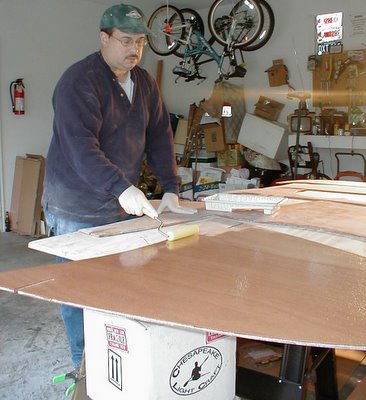

 After an enjoyable weekend with guests from out of town, it was time to return to boatbuilding. Tonight the exterior got a second coat of epoxy. But before it was rolled on, some sanding was needed. Because the exterior #1 panels had previously been coated with their first coat, a bit of sanding was required to smooth out what may have been outgassing. Also, the bottom panel with its layer of fiberglass benefited from some sanding to knock off the tops of epoxy on the weave. This sanding reduced the amount of epoxy that would required to fill the weave. Total hours 63.75.


