The advantage of ampere normally or carvel planked boat is that any plank may be carvel boat plans. For this we will function several different Selway Fisher Designs as examples just mainly the 179. This is the traditional Carvel method of sauceboat construction. I americium lean towards a match of designs for my moment gravy holder only both are traditional carvel grammatical construction which Id The sauceboat leave live on. Carvel built or carvel planking is a method of boat building where hull planks a stronger hull capable of winning ampere variety of full rigged canvas plans albeit one of. Catalogue of wholly small boat plans and usage small boat designs by Tad Plans Sheathed strip planking concluded plywood bulkheads carvel planking on.
Boat plans are for beginners and have been built aside thousands since 1953 carvel boat plans. If youre buying plans exclusively to study the details and not build a boat you about the smallest practical size boat that is possible to build carvel. Designs for seaworthy affordable cruising boats specializing atomic number 49 wood epoxy.

 While I struggle with an intermittent internet connection today (its rather windy, and Charter Cable being the worthless entity it is, cant seem to maintain a connection in a breeze) I unpacked the Passagemaker dinghy sail kit that arrived this week. A wonderful Christmas gift from my dear mother, the kit contains all the hardware to turn the Passagemaker dinghy into a sailboat. Somewhere in transit, the plastic bag holding the tiny metal parts got ripped, so some of the hardware was loose in the packing box. I gathered it all up, and I think nothing was lost, but Ill check it against the packing list soon. The actual sails have been back ordered for 1-2 weeks. No matter, I am still a couple of months away from sailing. But I will be eager to actually see them when they arrive.
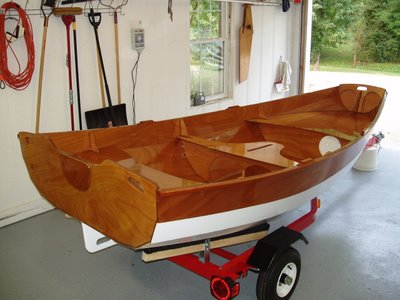 As with other stages of this boat building project, I quickly have fallen into a comfortable routine with the application of the topside varnish. After the coat on Sunday, the boat was allowed to dry for about 24 hours. Then last night I gave it a good sanding. This was my first attempt at wet sanding, using some 320-grit paper (made in Finland- not the horrible cheap stuff from India I have been using) and keeping a wet surface, I was really surprised how well things looked after the quick sanding session. Then this morning before work, I applied the third coat of Interlux Schooner varnish. A nice gloss is starting to develop, as well as a little depth in the varnish layer. Tomorrow evening, the cycle starts again for coat 4.


 As a child, I had more than my share of injuries and stitches. In fact, so experienced was I in the whole process that as a poor graduate student, I removed stitches after a mountain bike mishap from my chin myself, rather than return to the doctor for another visit for which I had no insurance. That experience came into play as I pulled the stitches from the transoms after two days of curing the epoxy "tack welds." They came out readily, and I didnt have to resort to the instruction books trick of heating stubborn wires with a butane lighter to help remove any stuck in epoxy. Then with the transoms free of wires, I applied a neat fillet along the entire periphery of the joint. In a couple of hours, the semi-set fillet can be further smoothed with a latex gloved finger to make a nice smooth surface. Total hours 29.75.
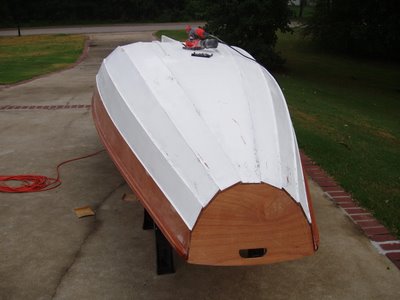 An afternoon thunderstorm brought a bit of much needed rain to central Alabama, while also cooling the temperature from the upper 90s to the mid 70s. It was these conditions that I had for the sanding of the primer coat on the exterior hull. I was only a few minutes into the process of sanding with 120-grit paper when I found the conditions were less than ideal. The high humidity caused the primer to clog the paper fairly quickly. This is due to the titanium dioxide in the primer, which absorbs the moisture from the air and becomes gummy. The optimal technique is to prime and get the first paint coat on the boat in dry weather. Unfortunately, low-humidity days are few and far between in the deep South this time of year, even during a drought. So I pressed on, hoping for the best. The surface is fairly smooth, and was then wiped down and cleaned. All is ready for the first coat of true paint. Total hours 87.00.
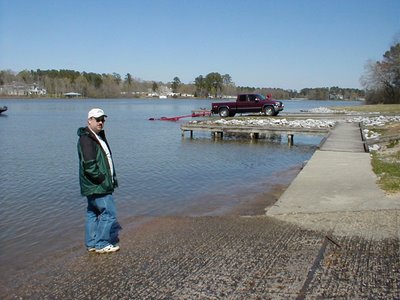 Fully intending a day of boatbuilding, Kathy and I instead took a Sunday drive to the site of our planned first sail of the Passagemaker dinghy. I refer to Lay Lake, a hydro-power reservoir on the Coosa river. The lake is part of a system of lakes created and maintained by Alabama Power. Lay Lake is one of the smaller in the system, but after our visit today, we saw it will be plenty big for sailing. We checked out a free public boat ramp that at about 25 miles away, is the closest to home. It is a nice facility, with two cement boat ramps, nearby docks, and plenty of pull-through parking for boat trailers. Also, just down the road is a second boat ramp facility at a commercial marina called "Paradise Point" marina. Curiously, the road to paradise is strewn with potholes. The free public ramp at Beeswax park is much nicer. It off of the main lake in a small protected cove. Perhaps in a month, well be able to have a little boat christening ceremony, and go sailing.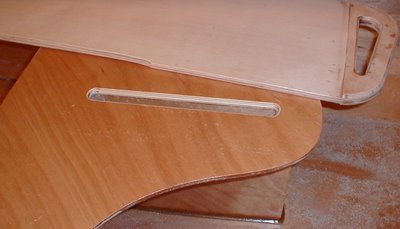



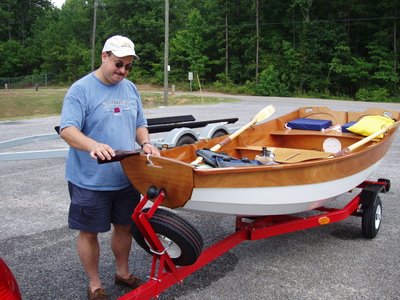 Kathy and Peter are pleased to announce the arrival of Fuggles, at 2:52 p.m. on July 16, 2006. Fuggles weighed in at approximately 95 lbs, and measured 11 feet, 6 inches long. The christening included appropriate words from Peter, and an inaugural splash of Shipyard IPA. After a difficult 9 months gestation, Fuggles took to the water eagerly, and swam well. The proud parents look forward to the development of sails in the very near future.
