The agenda for this evening was to assemble various parts in preparation for future use. So, with a batch of Cabosil-thickened epoxy mixed up, I set to the task of gluing and clamping. First was the mast coupler. The mast is made of two sections of aluminum pipe stock, joined by a coupler segment that fits tightly inside. Since this joint is not in the center of the mast, it raised the question (in the absence of any guidance from the instruction book) of whether the short segment should be at the top or the bottom of the mast. With all the engineering knowledge (1 semester of Intro to Civil Engineering, US Coast Guard Academy, 1984) and reasoning ability at my disposal, I arrived at the conclusion: it probably doesnt matter. But with the theory that placing the joint low would lower the lever arm of the infinitesimal weight of the coupler, I epoxied the coupler halfway into the longer mast segment. Then, as I epoxied the masthead plug into the other end of that same piece of pipe, I sealed my fate, as it were.
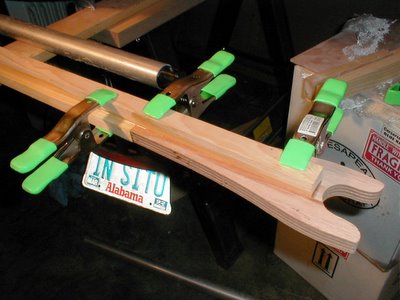
I went on to glue together the mainsail boom. This yard ends up having a T-shaped cross section as the two pieces of Cypress lumber are joined. A third piece of milled plywood is attached to the end to form a fork, which will ride against the mast- a simplistic boom gooseneck.
Next came the daggerboard handles, which are layers of cut plywood on either side of the large plywood daggerboard. These will later be shaped with a router for a nice smooth finish.
Finally, as my Cabosil-epoxy and clamps ran low, I joined the two thicknesses of plywood that make up the skeg. This fin-like structure will later be attached to the underside of the hull, giving some directional stability, protection during beaching, and a hand-hold when handling the boat out of water.
Total hours 47.00.
 The agenda for this evening was to assemble various parts in preparation for future use. So, with a batch of Cabosil-thickened epoxy mixed up, I set to the task of gluing and clamping. First was the mast coupler. The mast is made of two sections of aluminum pipe stock, joined by a coupler segment that fits tightly inside. Since this joint is not in the center of the mast, it raised the question (in the absence of any guidance from the instruction book) of whether the short segment should be at the top or the bottom of the mast. With all the engineering knowledge (1 semester of Intro to Civil Engineering, US Coast Guard Academy, 1984) and reasoning ability at my disposal, I arrived at the conclusion: it probably doesnt matter. But with the theory that placing the joint low would lower the lever arm of the infinitesimal weight of the coupler, I epoxied the coupler halfway into the longer mast segment. Then, as I epoxied the masthead plug into the other end of that same piece of pipe, I sealed my fate, as it were.